


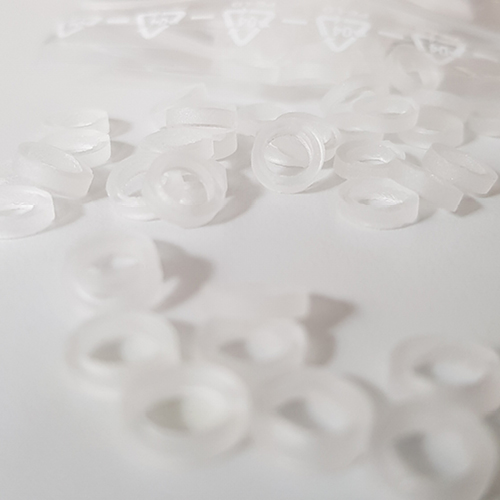
Rubber Bands in Orthodontic Treatment
Permanent braces (“fixed braces”) are a popular method for correcting misaligned teeth. “Braces elastics” is a term that comes up particularly often during treatment.
But what exactly does this mean, how are the rubber bands (“elastics”) used, and what function do they serve?
Fixed braces consist of various parts: brackets made of metal (as with the free braces), ceramic, or plastic, which are bonded to the surfaces of the teeth and connected by a wire. This wire is, in turn, attached to the brackets using smaller wires—which consist of very soft and thin metal ligatures. Braces elastics can be used in such a way that they connect the wire to the bracket instead of the ligatures, thereby helping to move the affected tooth into its correct position. In contrast, self-ligating brackets usually require neither elastics nor wires, as they feature a mechanism to which the wire can be attached directly. In addition, it may be necessary for compression or tension springs to be part of the braces. After all, the entire appliance exerts constant pressure on the teeth being corrected in order to move them into the correct position.
Even with “invisible” or “transparent” braces—the Invisalign method using clear aligners—no rubber bands are needed. Here, custom-fitted plastic aligners apply targeted pressure to the teeth. We’d be happy to provide you with more information and/or schedule a free initial consultation at our office in 1070 Vienna.
Information About the Invisalign Method
Another possible application is to place the orthodontic rubber band between the tooth and the fixed braces. The orthodontist may use this method to move the teeth in the dental arch into their final positions. This approach is used primarily for the final fine-tuning, ensuring that the rows of teeth close precisely (occlusion) at the end of treatment. The elastics are provided by the dentist and must be replaced regularly.
It is important to use the elastics exactly as your doctor has instructed you—after all, you need to be able to change them regularly and on your own. During the day, it’s recommended to change them every three hours; in addition, new elastics must be used before going to bed and after waking up. The elastics are designed to be disposable—they must therefore be discarded after a single use. Generally, the elastics do not need to be worn with the braces for the entire duration of treatment—the treating orthodontist will determine how long they need to be worn.
However, it is essential that they be worn consistently for the period specified by the orthodontist; otherwise, the treatment may be unnecessarily prolonged.
Are you unsure exactly how to use the braces elastics? The best thing to do is call us right away, and we’ll schedule an appointment to show you the correct way to use them again.
Don’t have braces yet, but are considering whether you need or want them? We’d be happy to advise you during a free, no-obligation consultation.